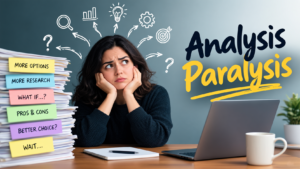
Ever Wonder Why Small Decisions Feel So Hard?
Have you ever stood in front of your closet for ten minutes, unable to choose a shirt, even though every option looks good? Or spent ages deciding what to order for dinner?
If that sounds familiar, you’re not alone. Decision fatigue in daily life is one of the most common reasons why small decisions can start to feel overwhelming.
Decision fatigue happens when your brain gets tired after making many choices throughout the day. Every decision, big or small, uses a little mental energy. As that energy runs low, even simple tasks like choosing a meal, replying to a message, or planning your day can start to feel difficult.
The good news is that decision fatigue in daily life is normal, and there are simple ways to manage it. By reducing unnecessary daily choices and creating simple routines, you can save your mental energy for the decisions that matter most.
What Is Decision Fatigue?
If you’ve ever wondered why small decisions feel so hard, decision fatigue could be the answer.
Decision fatigue is the mental tiredness that develops after making many decisions over a long day. As your brain processes one choice after another, it becomes harder to think clearly and make confident decisions.
This doesn’t mean you’re lazy or bad at making choices. It simply means your brain has reached its mental limit.
Think about how many decisions you make before lunchtime:
- What to wear
- What to eat for breakfast
- Which emails to answer first
- Whether to attend a meeting
- Which task to work on next
Each choice may seem small, but together they place a steady demand on your brain.
By the end of the day, your mental energy may be running low. That’s why small decisions feel so hard, and bigger choices such as making financial decisions, solving work problems, or planning for your family can feel even more stressful.
Recognizing decision fatigue is the first step toward managing it. Once you understand why small decisions feel so hard, you can build simple habits that reduce mental overload and make everyday decision making much easier.
Why Small Choices Feel Bigger Later in the Day
Have you noticed that making decisions feels easier in the morning than in the evening?
That’s because your brain has more mental energy at the start of the day. As the hours pass, every choice you make uses a little of that energy. By the end of the day, even simple decisions can feel harder than they should.
This isn’t just something that happens in everyday life. Researchers have seen the same pattern in jobs where people make important decisions.
A well-known 2011 study published in the Proceedings of the National Academy of Sciences found that parole board judges were more likely to approve parole early in the day or after a meal break. As they made more decisions, approvals became less common. The study suggested that mental fatigue can affect decision-making, even among experienced professionals.
If this can happen to trained judges, it’s easy to understand why choosing what to cook for dinner or which email to answer first can feel surprisingly difficult after a busy day.
Too Many Choices Can Make Decision Fatigue Worse
It’s not just the number of decisions that matters. The number of options matters too.
Imagine walking into a supermarket to buy toothpaste. Instead of choosing between two brands, you’re faced with twenty. Suddenly, a simple task takes much longer.
Researchers Eric Johnson and Daniel Goldstein found that when people have too many options, they often stick with the default or easiest choice rather than carefully comparing every option. Their 2003 study, published in Science, showed that people tend to avoid extra mental effort when making decisions.
This is one reason streaming platforms recommend movies, online stores highlight “Best Sellers,” and many apps suggest a default option. By reducing the number of choices, they make decisions feel quicker and less tiring.
When you understand how decision fatigue works, it becomes easier to see why reducing unnecessary choices can help you think more clearly throughout the day.
What Does the Research Say About Decision Fatigue?
Research suggests that decision fatigue is real, but scientists are still learning exactly why it happens.
An early theory by psychologist Roy Baumeister proposed that willpower works like a limited resource that gets used up after many decisions. However, a large 2016 study published in Perspectives on Psychological Science found little evidence to fully support that idea.
More recent research has shown mixed results. A 2025 study in Communications Psychology found no clear drop in decision quality among healthcare workers during their shifts. In contrast, a 2025 review in Health Psychology Review reported that many studies found decision fatigue affected choices such as prescribing medication and ordering tests.
Signs You’re Dealing With Decision Fatigue
You don’t need a lab study to notice it in your own life. Common signs include:
- Avoiding decisions altogether, even small ones like replying to a text
- Picking the same “safe” option every time, even when better choices exist
- Feeling unusually irritated by simple questions like “what do you want for dinner?”
- Making impulsive choices late in the day that you regret the next morning
- Struggling to compare options that used to feel easy
Simple Ways to Reduce Decision Fatigue
You can’t remove decisions from your day. But you can lower the mental cost of the ones that don’t matter much, so you save energy for the ones that do
Strategy | How It Helps |
| Set routines for small choices | Removes daily decisions like meals or outfits |
Make big decisions earlier in the day | Matches your natural focus peak |
Limit options before you choose | Reduces choice overload |
Reduces choice overload | Gives your focus room to reset |
Final Takeaway
Small decisions aren’t small when you make hundreds of them every day. Decision fatigue is a real pattern, even if scientists are still working out exactly why it happens. The fix isn’t complicated: cut down on choices that don’t matter, protect your focus for the ones that do, and be kind to yourself on the days when even picking dinner feels hard. That’s not a flaw in your thinking. It’s just a brain that’s been working hard all day.
If this pattern sounds familiar, start with one change this week: pick a default choice for one daily decision, like breakfast or your workout time, and notice how much lighter your day feels.
Frequently Asked Questions
1. What is decision fatigue?
Decision fatigue is mental tiredness that develops after making many decisions throughout the day. As your mental energy decreases, even simple choices can feel difficult, leading to slower or less thoughtful decisions.
2. Is decision fatigue real?
Yes. Research suggests that decision fatigue is a real experience, although scientists continue to study its exact cause. Many studies show that making repeated decisions can affect focus and judgment over time
3. What are the common signs of decision fatigue?
Common signs include struggling with small decisions, choosing the easiest option, putting off choices, feeling mentally drained, and becoming frustrated by simple questions.
4. How can I reduce decision fatigue?
You can reduce decision fatigue in daily life by creating daily routines, limiting unnecessary choices, making important decisions early in the day, taking short breaks, and getting enough sleep.
5. Can decision fatigue affect work performance?
Yes. Decision fatigue can make it harder to concentrate, solve problems, and make confident decisions. This may affect productivity and the quality of your work.
6. Is decision fatigue the same as burnout?
No. Decision fatigue is short-term mental exhaustion caused by making many decisions, while burnout is long-term physical and emotional exhaustion related to ongoing stress.
7. Who is more likely to experience decision fatigue?
Anyone can experience decision fatigue, but it is more common among professionals, caregivers, parents, students, and people who make frequent or high-pressure decisions throughout the day.
8. When should I seek professional help for decision fatigue?
If decision fatigue continues for weeks, affects your work or relationships, or is accompanied by ongoing anxiety, stress, or low mood, consider speaking with a mental health professional or psychiatrist for guidance